

Data Privacy Brasil takes part in the Third Pall Mall Process Conference in Paris
On 10 and 11 November, our researcher Paula Uematsu Arruda represented Data Privacy Brasil at the Third Pall Mall Process Conference in Paris, following an invitation from the Capacity Building for Cybersecurity and Artificial Intelligence programme, Expertise France, and the French Ministry for Europe and Foreign Affairs.
On 10 and 11 November, our researcher Paula Uematsu Arruda represented Data Privacy Brasil at the Third Pall Mall Process Conference in Paris, following an invitation from the Capacity Building for Cybersecurity and Artificial Intelligence programme, Expertise France, and the French Ministry for Europe and Foreign Affairs. On the first day, discussions took place at the Ministerial Conference Centre. On the second day, the conference moved to the Paris Peace Forum at the Palais de Chaillot. Over the two days, participants discussed how to ensure the responsible governance of the market for commercial cyber intrusion capabilities (CCICs), a category that includes spyware.
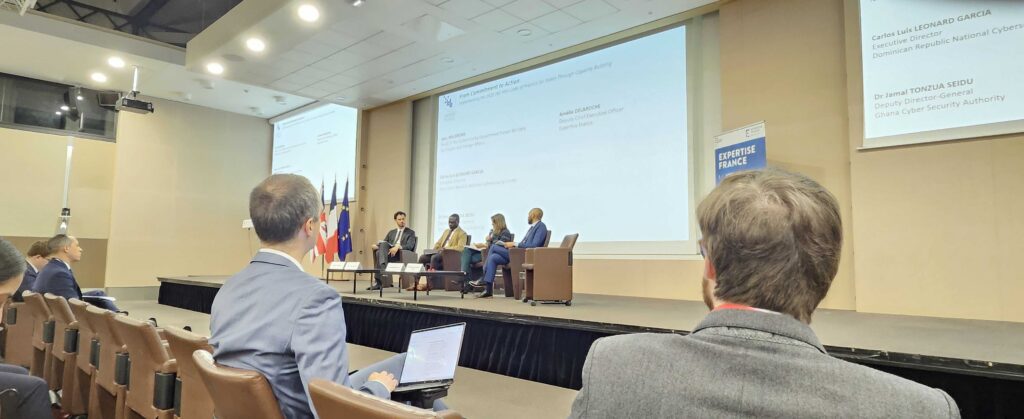
The Pall Mall Process was launched by the governments of the United Kingdom and France in February 2024 as a voluntary, non-binding international initiative to address the misuse of cyber intrusion tools. It followed a series of revelations that spyware had been used to surveil journalists, activists, political opponents, lawyers and public officials in different countries. These revelations brought the issue beyond the technical field of cybersecurity and into a broader debate about human rights, democratic accountability and national security.
It is estimated that more than 100 countries, representing over half of the world’s governments, have access to commercial spyware. Against this backdrop, the Pall Mall Process held a public consultation between August and October 2024, followed by the publication of a report on its findings in January 2025. In April 2025, the Code of Practice for States was adopted. As of June 2026, the Code had 27 signatory governments and was structured around four core pillars, namely accountability, precision, oversight and transparency. The process then moved forward with a second public consultation, focused on industry practices, which ran from November 2025 to January 2026. This was followed by a round of negotiations between August and October 2026, which Data Privacy Brasil took part in.
The main outcome of this latest stage was the Guidelines for Industry, launched on 11 November 2026, at the close of the conference in Paris. The document brings together practical recommendations for companies operating in the sector and complements the Code of Practice for States. The Guidelines have been endorsed by 14 countries, namely Austria, the Bahamas, Costa Rica, France, Germany, Italy, Japan, Luxembourg, the Netherlands, Poland, Slovakia, Switzerland, the United Kingdom and the United States. The Code, in turn, had 27 signatory governments as of June 2026, according to the Business & Human Rights Resource Centre.
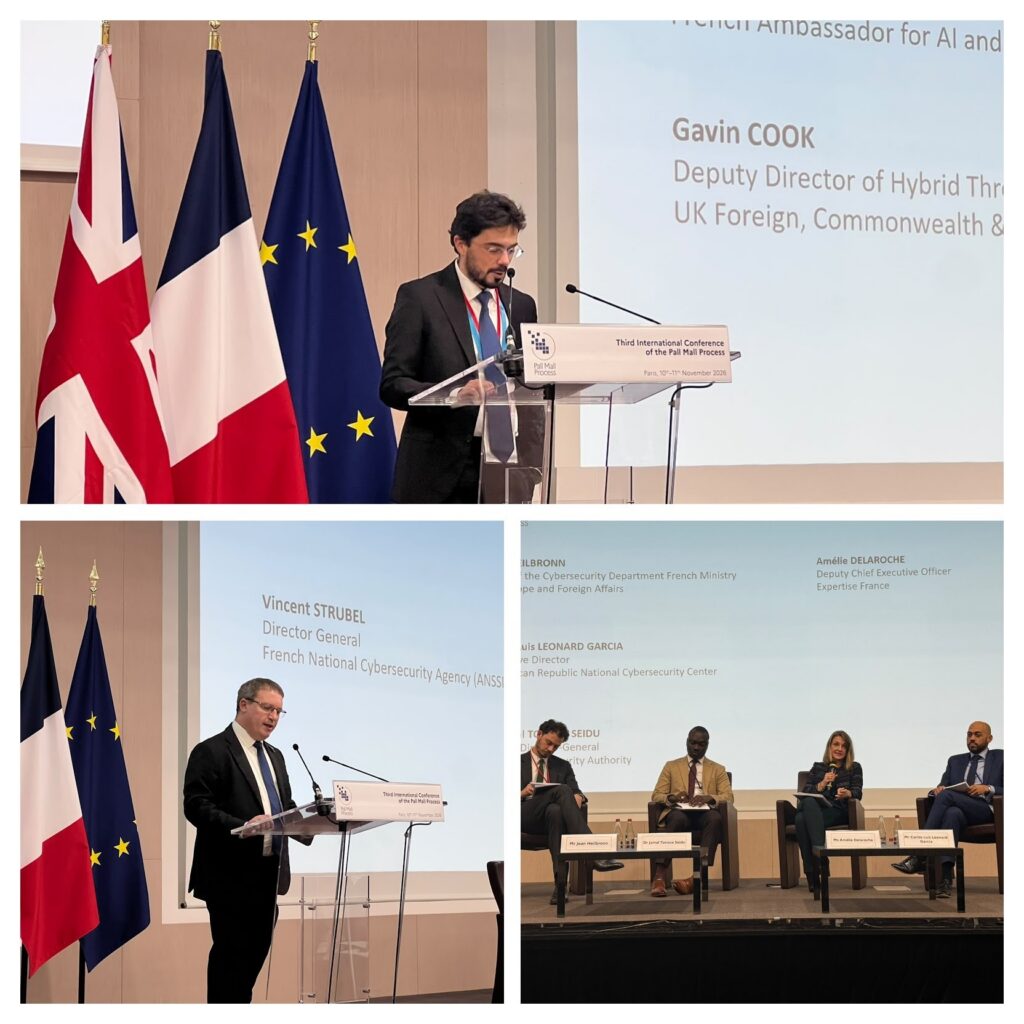
The Paris conference brought together representatives from civil society organizations that actively follow developments in this area, including Protect NGO, Freedom House, the Business & Human Rights Resource Centre, Reporters Without Borders, Access Now and Virtual Routers.The program included a dedicated panel on the role of civil society in raising awareness, promoting advocacy and strengthening accountability. Their participation is essential, as these organizations systematically document abuses involving CCICs and advocate for effective oversight and monitoring mechanisms, as well as publicly available indicators and reports, to ensure that commitments translate into concrete action rather than remaining on paper. The event also brought together government representatives from several Latin American countries, including Uruguay, Chile, the Dominican Republic, Colombia, Costa Rica and Guatemala.
The Pall Mall Process is significant because it has established an unprecedented space for international dialogue on the spyware market and other intrusive technologies. However, the initiative has also faced criticism from civil society organizations, which have raised concerns about the voluntary and non-binding nature of the commitments made, the lack of effective oversight and accountability mechanisms, and the risk that the process could help legitimize a market built around technologies that violate human rights. There are also concerns about the lack of concrete evidence that the dialogue has translated into meaningful progress in implementing regulatory measures and preventing abuses by governments and companies in the sector. Data Privacy Brasil will therefore continue to closely monitor the process and contribute actively to this debate.
Veja também
-

Brazil’s Expanding Surveillance System: Security at the Cost of Privacy?
From facial recognition in public spaces to citizen reporting apps and private-sector image sharing, Brazil is moving toward a broader surveillance ecosystem, raising questions about who is being watched, who controls the data, and what safeguards are in place.
-
COP30, Data and Land Use: Discussing Agendas to Combat Land Grabbing
On November 12, 2025, Data Privacy Brasil held a roundtable discussion on data and land grabbing as part of the COP do Povo program, a parallel event to COP30, entitled "COP30, Data and Land Use: Discussing Agendas to Combat Land Grabbing,".
-

COP30: Why local communities must have access to environmental information in data center development
At COP30, Brazil speaks of reforestation and indigenous wisdom. But Bruno Bioni, Mariana Rielli, and Rafael Zanatta argue that the country’s generous tax incentives for data centers must be tied to the collective right of access to environmental information, or risk deepening the very injustices the climate summit seeks to undo.
-
COP30 Dialogues: Interview with Antônio Laranjeira
In the second interview for our special series “COP30 Dialogues: Digital Rights and Climate Justice,” we spoke with Antônio Laranjeira, an award-winning journalist for investigative reporting on topics such as environmental loss and damage, science, and citizenship.
-

COP30 Dialogues: Interview with Lori Regattieri
Data Privacy Brasil launches the new interview series “COP30 Dialogues: digital Rights and Climate Justice,” aiming to hear diverse voices on the interface between the climate agenda and digital rights. The new project emerges in a unique year: the first United Nations Climate Change Conference (COP30) in Brazil.
-
Why public transparency on certain personal data is essential to guarantee environmental justice?
Between 2022 and 2023, Data Privacy Brasil developed the project Environment and Information: contesting the political instrumentalization of LGPD in Environmental Regulation which focuses on the intersection of digital rights and environmental policies.
-
Digital Public Infrastructures & Digital Public Goods for Combating Climate Change: The Brazil Case Study
Data Privacy Brasil, with the support of the Digital Public Goods Alliance (DPGA), launches a new report that aims to analyze the integration between Digital Public Infrastructure (DPI) and Digital Public Goods (DPGs) as tools to combat climate change.
Veja Também
-
Brazil’s Expanding Surveillance System: Security at the Cost of Privacy?
From facial recognition in public spaces to citizen reporting apps and private-sector image sharing, Brazil is moving toward a broader surveillance ecosystem, raising questions about who is being watched, who controls the data, and what safeguards are in place.
-
COP30: Why local communities must have access to environmental information in data center development
At COP30, Brazil speaks of reforestation and indigenous wisdom. But Bruno Bioni, Mariana Rielli, and Rafael Zanatta argue that the country’s generous tax incentives for data centers must be tied to the collective right of access to environmental information, or risk deepening the very injustices the climate summit seeks to undo.
-
COP30 Dialogues: Interview with Antônio Laranjeira
In the second interview for our special series “COP30 Dialogues: Digital Rights and Climate Justice,” we spoke with Antônio Laranjeira, an award-winning journalist for investigative reporting on topics such as environmental loss and damage, science, and citizenship.
-
COP30 Dialogues: Interview with Lori Regattieri
Data Privacy Brasil launches the new interview series “COP30 Dialogues: digital Rights and Climate Justice,” aiming to hear diverse voices on the interface between the climate agenda and digital rights. The new project emerges in a unique year: the first United Nations Climate Change Conference (COP30) in Brazil.
-
Why public transparency on certain personal data is essential to guarantee environmental justice?
Between 2022 and 2023, Data Privacy Brasil developed the project Environment and Information: contesting the political instrumentalization of LGPD in Environmental Regulation which focuses on the intersection of digital rights and environmental policies.
-
Digital Public Infrastructures & Digital Public Goods for Combating Climate Change: The Brazil Case Study
Data Privacy Brasil, with the support of the Digital Public Goods Alliance (DPGA), launches a new report that aims to analyze the integration between Digital Public Infrastructure (DPI) and Digital Public Goods (DPGs) as tools to combat climate change.
-
Transparent monitoring for sustainability through DPIs
In this new publication, researchers Gabriela Vergili, Pedro Saliba from Data Privacy Brasil, Vinay Narayan and Soujanya Sridharan from Aapti Institute, discuss the “Transparent monitoring for sustainability through DPIs”.
-
Privacy, Public Transparency and Climate Change
How transparency and data protection can help environmental public policies in Brazil.

DataPrivacyBr Research | Content under licensing CC BY-SA 4.0