
Data Privacy Brasil participates in international seminar on Brazil’s Digital Statute for Children and Adolescents
Yesterday, Data Privacy Brasil took part in the seminar “Online Safety for Children Statute: Lessons from the Brazilian Experience”, organized by Digital Action and Conectas Human Rights. Check out our report featuring the key highlights from the event.
Yesterday, Data Privacy Brasil took part in the seminar “Online Safety for Children Statute: Lessons from the Brazilian Experience”, organized by Digital Action and Conectas Human Rights.
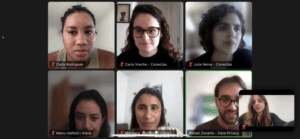
The session, mediated by Carla Vreche (Conectas), brought together organizations working at the forefront of childhood and digital rights, including Emanuella Halfeld (Alana Institute) and Rafael Zanatta (Data Privacy Brazil), to discuss the development and approval of Brazil’s groundbreaking Digital Statute of Children and Adolescents (DSCA), the first national law dedicated to protecting children in online environments.
During his contribution, Rafael Zanatta presented a detailed overview of the political, regulatory, and social processes that shaped the DSCA, drawing on Data Privacy Brasil’s long-term engagement with the topic. He highlighted the statute’s foundations in integral protection, the central role of civil society in shaping safeguards against commercial exploitation, and the careful balance achieved to avoid mass surveillance and ensure democratic accountability. Zanatta also explained how the law incorporates strong privacy-by-design requirements, establishes preventive duties for digital services, and assigns regulatory enforcement to independent authorities, reinforcing that the DSCA is not a censorship mechanism but a rights-based framework built through broad coalition-building and public deliberation.
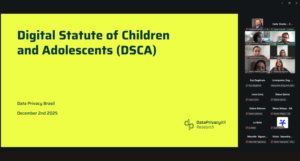
As Brazil moves toward the implementation phase of the DSCA in 2026, Data Privacy Brasil will continue to contribute with technical analysis, institutional dialogue, and evidence-based research to ensure that the statute fulfills its promise of strengthening protections for children in digital environments. Our participation in international and national forums remains an essential part of this effort, fostering cooperation and advancing a rights-based approach to digital governance.
Veja também
-

Data Privacy Brasil launches the AI Harm Library
Our repository systematizes evidence of harm caused by AI systems and reveals that nearly 29.6% of the documented harms directly affect psychological and social well-being. Learn more about the new initiative!
-
Brazilian Senate approves Landmark Digital Child Protection Bill: what are the next steps?
On 27 August 2025, Brazil's Senate approved Bill PL 2628/2022, focused on protecting the rights of children in digital platforms. What happens now?
-
Artificial Intelligence in Focus: A Comparative Analysis of the BRICS and FOC Declarations on AI Governance
The BRICS Leaders' Declaration on Global Governance of Artificial Intelligence has gained prominence in both Brazilian and international media, as it represents a joint position by Global South countries in the ongoing contest over this emerging technology.
-

AI Explainability: How to Avoid Rubber-Stamping Recommendations
Experts debate if human oversight can replace the need for the explainability of AI systems. Bruno Bioni, co-director of Data Privacy Brasil, was one of the experts interviewed. Check it out in the text!
-

Digital Merger Watch: Data Privacy Brasil joins new global initiative
The group includes national and international organizations and will focus on analyzing and challenging Big Tech’s efforts to reinforce its dominance through mergers and acquisitions.
-

Beyond Digital Rights: Towards a Fair Information Ecosystem?
One of the major challenges in the field of digital rights is the tendency toward segmentation and hyper-specialization in topics such as privacy, freedom of expression, net neutrality, data protection, and the regulation of AI systems. Learn more about the topic in the article published in Tech Policy.
-
Global AI governance: Taking action with civil society
More than 40 civil society organizations call for inclusion in AI Action Summit in letter on global governance of Artificial Intelligence.
Veja Também
-
Data Privacy Brasil launches the AI Harm Library
Our repository systematizes evidence of harm caused by AI systems and reveals that nearly 29.6% of the documented harms directly affect psychological and social well-being. Learn more about the new initiative!
-
Artificial Intelligence in Focus: A Comparative Analysis of the BRICS and FOC Declarations on AI Governance
The BRICS Leaders' Declaration on Global Governance of Artificial Intelligence has gained prominence in both Brazilian and international media, as it represents a joint position by Global South countries in the ongoing contest over this emerging technology.
-
AI Explainability: How to Avoid Rubber-Stamping Recommendations
Experts debate if human oversight can replace the need for the explainability of AI systems. Bruno Bioni, co-director of Data Privacy Brasil, was one of the experts interviewed. Check it out in the text!
-
Digital Merger Watch: Data Privacy Brasil joins new global initiative
The group includes national and international organizations and will focus on analyzing and challenging Big Tech’s efforts to reinforce its dominance through mergers and acquisitions.
-
Beyond Digital Rights: Towards a Fair Information Ecosystem?
One of the major challenges in the field of digital rights is the tendency toward segmentation and hyper-specialization in topics such as privacy, freedom of expression, net neutrality, data protection, and the regulation of AI systems. Learn more about the topic in the article published in Tech Policy.
-
Global AI governance: Taking action with civil society
More than 40 civil society organizations call for inclusion in AI Action Summit in letter on global governance of Artificial Intelligence.
-
The Artificial Intelligence Legislation in Brazil: Technical Analysis of the Text to Be Voted on in the Federal Senate Plenary
The Internal Temporary Artificial Intelligence Committee (CTIA) of the Federal Senate approved the substitute report for Bill 2338/2023. This bill aims to define the legal framework for regulating the use of Artificial Intelligence systems in Brazil.
-
AI in the 2024 Brazilian elections
Aláfia Lab, *desinformante and Data Privacy Brasil launch the report “AI in the 2024 Brazilian elections”, with an analysis of the use of artificial intelligence in the first round of the elections.
-

A Fragmented Landscape Is No Excuse for Global Companies Serious About Responsible AI
For the third year in a row, MIT Sloan Management Review and Boston Consulting Group (BCG) have brought together an international panel of AI experts to help gain insights into the lack of alignment around global standards and norms for responsible AI. Bruno Bioni, co-director of Data Privacy Brasil, was one of the experts interviewed. Check it out in the text!
-

Research Project Outcomes: A vision for inclusive educational technology
Check out Júlia Mendonça's interview for Tech Ethics Lab, about the use of technology in schools.
-
Key Themes in AI Regulation: The local, regional, and global in the pursuit of regulatory interoperability
Data Privacy Brasil releases its report “KeyThemes in AI Regulation: The local, regional, and global in the pursuit of regulatory interoperability,” supported by the Heinrich Böll Foundation. This work is the result of months of research under the project “Where the SabIA Sings: Governance and Regulation of Artificial Intelligence from Brazil”.
-
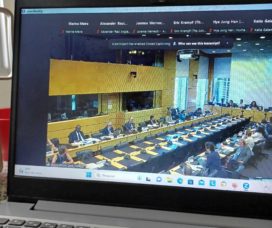
Data Privacy Brasil participates in UN’s OHCHR briefing on Brazil
The organization highlighted how the advance of edtech has been violating children’s privacy in the country

DataPrivacyBr Research | Content under licensing CC BY-SA 4.0