
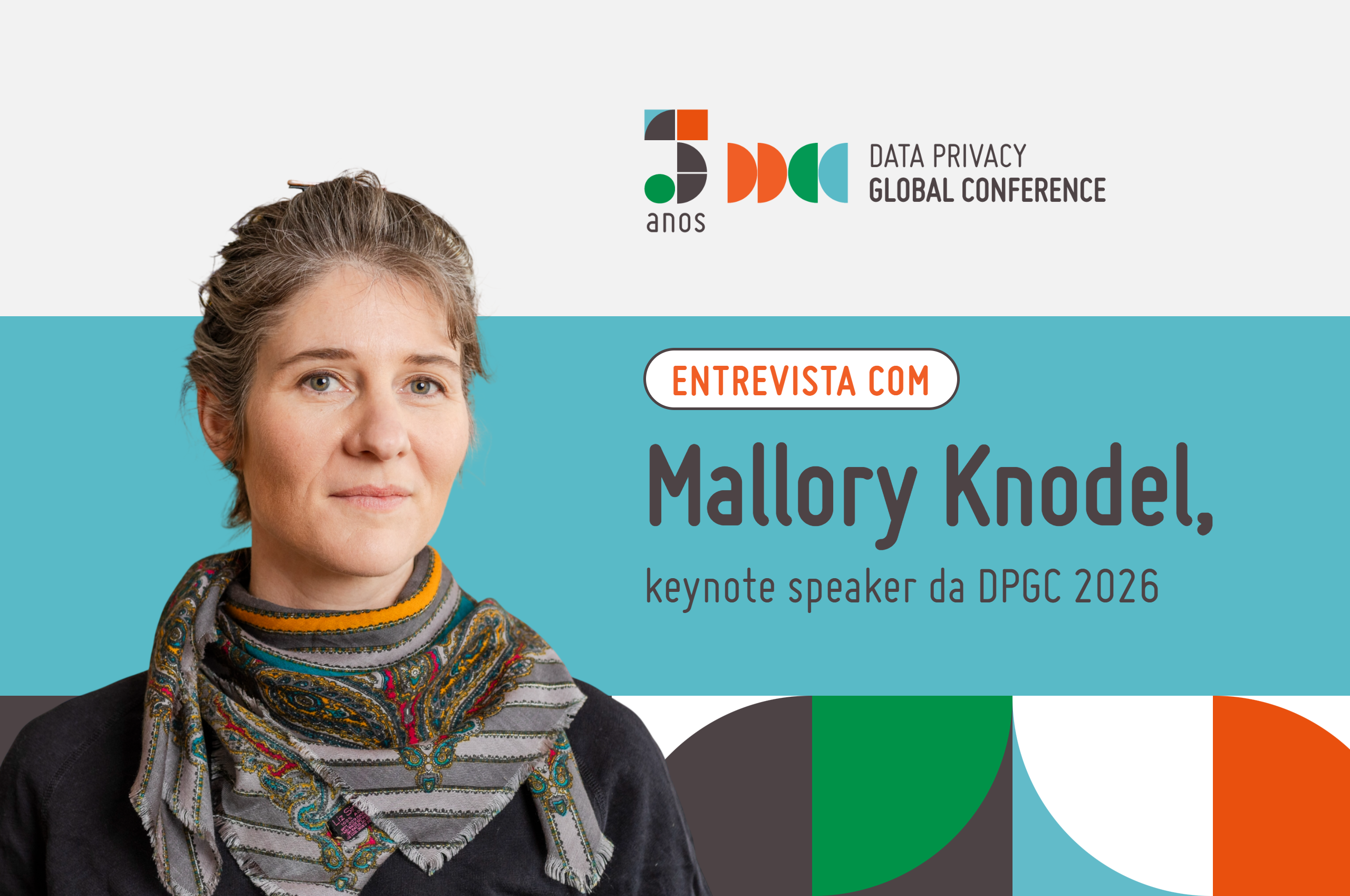
Interview with Mallory Knodel
With nearly two decades of experience at the intersection of technology, human rights, and internet governance, Mallory Knodel has built a career combining cryptography research, digital rights advocacy, and participation in international technical standards-setting processes. As a feminist technologist and Executive Director of the Social Web Foundation, her work is grounded in a perspective that considers the power dynamics embedded in the architecture and development of digital technologies.
With nearly two decades of experience at the intersection of technology, human rights, and internet governance, Mallory Knodel has built a career combining cryptography research, digital rights advocacy, and participation in international technical standards-setting processes. As a feminist technologist and Executive Director of the Social Web Foundation, her work is grounded in a perspective that considers the power dynamics embedded in the architecture and development of digital technologies.
At the Data Privacy Global Conference – DPGC 2026, Mallory will deliver the keynote Detection, Verification and Agents: Today’s Privacy Challenges. Her talk addresses issues that are becoming increasingly relevant as artificial intelligence systems are integrated into digital services, particularly the challenges surrounding content detection, verification mechanisms, and the role of AI agents.
In this interview with Data Privacy Brasil, Mallory discusses the experiences that have shaped her professional journey, the limitations of platforms’ approaches to content moderation and gender-based violence, the risks associated with age verification, and the need to preserve privacy and end-to-end encryption as artificial intelligence agents become more widespread.
1. Your work has spanned internet architecture, cryptography, digital rights, and global internet governance. Looking back at your career, what key experiences have most shaped the way you understand the relationship between technology and human rights today?
Four experiences have shaped me most. I did media and technology work for the World Social Movements, which brought me to Brazil several times. Working within big social movements to counter globalization early in my career has shaped my work ever since. We’ve seen unprecedented repression of global solidarity movements and the erosion of civic space offline as well as online, using digital technologies.
I am a trained educator and I worked for many years to protect human rights defenders with digital security trainings. Teaching has helped me to be a better technologist, a better communicator and to understand that we need to tackle some problems from the top down, not just bottom up because they are too big.
To that end I have learned a lot in that top-down work such as in global standards setting, which is an attempt at fixing the human rights issues inherent in internet architecture for everyone, but from the perspective of those most vulnerable.
But advocating directly with corporations has limited results. Companies ultimately do what they want and this can erode trust and especially the budgets of nonprofits that work hard to improve corporate products, so I am also shaped by my feminist politics to build our own spaces and that includes our own technologies.
I want to see alternatives that are just as good if not better for human rights, built with the principles of our movements, that everyone can use and benefit from without having to rely on corporate products.
2. Over the years, debates around content moderation have raised important questions about the relationship between privacy, freedom of expression, and the protection of users. Drawing on your work on content moderation in end-to-end encrypted systems, what should we consider when evaluating new proposals to address online harms? What can happen when the balance between these rights is not properly maintained?
Over a decade ago, David Kaye, then UN Special Rapporteur on freedom of expression, made the link between privacy and other human rights in his report on encryption and anonymity. And five years ago my colleagues and I wrote in Outside Looking In, a Center for Democracy & Technology paper on content moderation in end-to-end encrypted systems, in which we elaborate the ways that content moderation techniques do or do not erode privacy as well as free expression, in an effort to reduce content harms.
We have known for a long time that if the balance between these rights isn’t right, it leads to downstream human rights abuses, platform monopolies, regulatory capture, network centralization, and inequities in access. It’s important to revisit and reframe these issues anytime there are new proposals on the table.
3. In Brazil, the AI in Elections Observatory, an initiative by Data Privacy Brasil and Aláfia Lab, has documented how AI-generated content, including non-consensual sexual deepfakes, can be used to target women in politics. Beyond the immediate harm to individuals, how does this form of gender-based political violence affect women’s political participation and representation? And to what extent do platform policies, design choices, and failures to act contribute to enabling or normalizing these attacks?
This is a multi-layered problem. I want to take it from a feminist analysis of power. It starts with the idea that women shouldn’t have power, and with the discomfort around gender equality that is in every home, every relationship, and every workplace. Women who are running for elected office are very visible, and as part of the democratic process, everyone has access to and exposure to those women seeking power. I say this because we have to think about the underlying social cause.
This then becomes a tech problem because society has constructed many ways to disempower women. You can attack her reputation, her relationships, her sexuality, her personhood, her body. All of the taboos around these things are socially constructed. Online spaces platform these taboos by facilitating visibility, access and amplification.
The decision-makers who created these platforms have the same social conditioning that the rest of us do, and they have authority over how their platform alleviates or exacerbates problems of power. Historically, platforms have not done much. Abuse of women on platforms is ignored because to varying degrees it is normalized socially. What counts as harm also differs across cultures: in some cultures, being shown with your hair uncovered, or wearing clothes that expose any part of your skin, could be seen as harm. A platform first has to understand the harm, its impact, and its remedy and for a long time platforms weren’t listening to women’s rights groups about this.
Platforms are also designed to inflame debate, conversation, and activity. Advertising is about content engagement, and content engagement is driven more by negative content than positive. This is all to point out that platforms have to actively work against this trend, it cannot just be reactive. The visionary thing to do is to use platform power to fix what’s wrong with the world, not just what’s happening on their platforms, which, by the way, they are also still largely failing to do.
I’m a technologist, and you might have noticed I didn’t really say anything about technology. There are some technical solutions for content moderation, like those my colleagues and I examined in Outside Looking In.
4. Brazil’s Digital ECA (Digital Statute of the Child and Adolescent), enacted in 2025, establishes new requirements for age assurance mechanisms, while also setting safeguards related to privacy, data minimization, and purpose limitation. As similar measures are being discussed and implemented in different parts of the world, what should policymakers consider when designing age-verification systems? How can these mechanisms effectively protect children and adolescents without creating new infrastructure for surveillance or restricting people’s access to digital spaces?
The first thing to establish is whether there are legal imperatives to require everyone to show identification whenever they take a certain action. In most countries, there is no legal imperative for accessing online content. Even for pornography, there are not a lot of laws on the books that ban the consumption of pornographic content based on age. Until you have a legal imperative to check every single person who takes a certain action, it makes no sense to start talking about age verification with rigor and depth. As a technologist, I defer to you all who are legal experts.
The status quo is to ask for services to ask for age because the service is inappropriate for certain ages. A service might not be designed to handle users who are children, say because the platform makes money off of advertising and children very frankly don’t have money to shop online. Or there are versions of apps made just for kids, like Instagram’s Teen Accounts, YouTube’s “made for kids” setting, or education apps targeted at elementary-aged children. So this is why we have things like putting in your own birthday when you sign up for an account, to ensure that the service is right for the user based on age. Admittedly this is imperfect if there are indeed legally backed content bans in place.
So the first thing is a legal imperative. The second thing is identifying how rigorously the age of every single person who takes that action must be verified. And where we place that verification can either make everyone less private, or take a harm-reduction approach and better balance privacy. Must it be that one’s government issued identity and biometric data is an appropriate request to view a website? Again, this verification would be performed for every single user.
Third thing is to consider which intermediary would perform this verification. Is it each and every website? Let’s look at a different example: if you require verification by some identity service, then a mobile operating systems could hold a token, which can be passed to apps or the app store where you get your apps. This scheme has the unintended consequence that now every every app, every service is incentivized to request that token, because that extremely reliable, iron-clad signal builds a dossier about all of the users on the internet. So whether or not a service even needs that information, it could ask for it and save it and use it now or later or sell it, etc.
Our example would also be ineffective, because many people access content through websites rather than apps, and even web browsers themselves don’t really work in this manner. Nor would it be appropriate to ask for an age signal to download a general piece of software like a web browser.
And then we get into this whole issue around circumvention. Whichever of these options you choose to actually do the verification, whether it’s on the service, on the phone, or telecommunications companies, you then realize it could be easily circumvented just by accessing the content in a different way. That’s because we built the internet and the web around the idea that you have multiple versions of services and information that can be displayed in different ways to people in different jurisdictions.
Worrying about circumvention sweeps in bans or restrictions on VPNs and other kinds of really important privacy-preserving features and services that activists need to stay safe, that women need to stay safe. And so you start going after those, too, and I hope it’s apparent that at that point we’ve gone too far off balance.
5. As AI agents become more integrated into digital services and decision-making processes, how can developers and policymakers preserve strong privacy guarantees and end-to-end encryption? What principles should guide the development of rights-respecting AI systems?
I would say AI agents fall into two categories. The first category is what a lot of folks are using if they’re interfacing with LLM technology like ChatGPT, Claude, or Meta AI. But then there are a lot of agents being built around existing services, tools, and websites.
On the one hand, we expect the first category, the chatbots, to be on our side: we’re asking them for advice, or we’re doing something and they’re helping us. But we don’t really expect an agent from an airline, a car manufacturer, or a food-ordering service to be “our” agent. Those agents are working on behalf of the company that made them to replace speaking with a real employee.
This difference also matters when we think about decision-making. I think people are really worried about that first category of AI agents, the ones that seem to be on our side, making decisions for us or taking actions on our behalf. There are people who work in this field who feel very strongly that this just shouldn’t be possible. People have to make decisions, and agents must only carry out those decisions and shouldn’t be working autonomously. Reality is going to wind up somewhere in the middle, and it’s important that people have a healthy understanding of who the agent is built by, for whom, and in whose interests they have top of mind when they’re operating.
And we should be very, very worried about inviting them into our confidence, and the confidence of the people we talk with, like in messaging apps. We’ve felt as a community for a long time that those conversations are so important they need to be protected by end-to-end encryption, which cuts the service provider out from being able to see their content.
If you invite in an AI agent, you no longer have that protection, and companies are really motivated to invite themselves into your chats as a new source of data to train their models, sell you things, and grab your engagement. So we need to draw a very bright line here, and that’s what my ongoing work is about: keeping agents out of confidential messaging, and making sure that when people do use AI on their private data, the computation itself stays confidential.
***
Veja também
-
Data Privacy Global Conference 2023 started today
Data Privacy Global Conference, organized by Data Privacy Brasil, started this Monday (November 27th) in São Paulo, at the ESPM School.
-
Data Privacy Global Conference 2023: an overview
The second edition of the Data Privacy Global Conference brought together professionals from more than one hundred civil, business and government organizations in a two-day event in the city of São Paulo, between November 27th and 28th, 2023. With more than 20 sponsors, the 2023 DPGC edition was a public success, with more than 250 participants.
Veja Também

DataPrivacyBr Research | Content under licensing CC BY-SA 4.0